pixel John Krull, Author at Tech Reformers

Author Archives: John Krull

Agent Core enable agentic AI as a managed service.

The cloud security conversation just expanded beyond IAM policies and S3 bucket permissions. AWS has published four core security principles aimed specifically at agentic AI systems. And if you work in cloud architecture, security, or AI development, this framework belongs in your professional toolkit. Agentic AI doesn’t just generate text. Now it reasons, plans, and takes action by connecting to APIs, tools, and live data sources. That autonomy is powerful, but it introduces attack surfaces and risk vectors that most cloud professionals haven’t had to think about before. Understanding these principles isn’t optional anymore. It’s becoming a core competency for anyone building or securing modern cloud workloads. Whether you’re preparing for a certification or architecting production systems, this is the kind of foundational shift worth understanding deeply.

What Makes Agentic AI Different From Everything That Came Before

To understand why new security principles are needed, you first have to appreciate what makes agentic AI fundamentally different. Traditional software executes predictable, hardcoded instructions. The security model is relatively contained. Generative AI advanced things by responding to natural language prompts, but humans remained in the loop, reviewing outputs before any action was taken. Agentic AI removes that human checkpoint. The model itself plans sequences of actions, selects tools, calls APIs, and executes workflows with varying degrees of autonomy.

Amazon Bedrock AgentCore is an agentic platform for building, deploying, and operating effective agents securely at scale—no infrastructure management needed. 

https://aws.amazon.com/bedrock/agentcore

This means

  • a single compromised prompt,
  • a misconfigured tool permission,
  • or an overly permissive IAM role attached to an agent

can have cascading real-world consequences. The blast radius of a security failure in an agentic system is categorically larger than in prior AI paradigms.

Where to Start

The Agentic AI Security Scoping Matrix helps organizations calibrate the rigor of these controls based on their system’s level of autonomy.  Scopes range from systems that require explicit human approval for every action to fully autonomous systems that initiate their own actions in response to external events.

The Four Security Principles for Agentic AI

AWS has outlined four principles that should guide the design and operation of agentic AI systems. The principles center on themes that experienced cloud professionals will recognize:

  1. least privilege access,
  2. strong identity and authentication boundaries,
  3. input and output validation (including protection against prompt injection), and
  4. maintaining human oversight at meaningful decision points.

What’s significant here is that AWS is applying classic security thinking, the kind baked into the Well-Architected Framework’s Security Pillar, to an entirely new category of workloads. These aren’t abstract ideas; they map directly to how you configure Amazon Bedrock Agents, what permissions you assign to Lambda functions invoked by agents, and how you design guardrails using Amazon Bedrock Guardrails. The principles are designed to be practical and implementable today, not aspirational guidance for a future state.

Real-World Scenario: Securing a Bedrock Agentic AI

Picture a financial services company deploying an Amazon Bedrock Agent to help relationship managers retrieve account summaries, flag compliance issues, and initiate document requests. Without proper security design, that agent could be manipulated via prompt injection to retrieve data outside its intended scope, or an over-permissioned tool connection could expose sensitive customer records.

Applying AWS’s four principles,

  • The architect would enforce least privilege on every API action the agent can invoke,
  • Implement input validation to detect and block adversarial prompt patterns, and require human confirmation before the agent triggers any financial transaction.
  • Amazon Bedrock Guardrails would be configured to filter outputs and restrict topic scope, and
  • AWS CloudTrail would log every agent action for audit and incident response purposes. This is exactly the kind of design decision that separates a secure AI deployment from a headline-making breach.

Certification Domains and Job Roles This Directly Supports

This content sits at the intersection of several high-value certification domains. Candidates preparing for the AWS Security Specialty will find this directly relevant to threat modeling, least privilege design, and data protection strategy — all of which now need to account for agentic workloads.

The AWS AI Practitioner exam covers responsible AI and foundational AI security concepts that reinforce these principles. Solutions Architect Professional candidates working through advanced security architecture and the Well-Architected Framework will also find this material applicable.

From a job-role perspective, Cloud Security Engineers, Gen AI Developers, and Solutions Architects are the professionals most immediately affected — but CloudOps engineers responsible for monitoring and incident response for AI-driven workloads need this context too. As agentic AI moves from pilot to production, this knowledge will appear in job descriptions and interviews, not just exam questions.

Why This Is the Right Time to Build These Agentic AI Security Skills

AWS publishing formal security principles for agentic AI is a strong signal that this architecture pattern is moving into mainstream enterprise adoption. Organizations that start applying these principles now. For certification candidates, getting ahead of emerging exam domains while they are still fresh gives you a meaningful advantage in both the test and in conversations with hiring managers. For enterprise practitioners, the cost of retrofitting security into an agentic AI system after deployment is always higher than building it in from day one. AWS has done the hard work of distilling these principles from real-world experience — the opportunity now is to apply them with confidence and depth.

Dig Deeper

When you get a chance, be sure to read the full post by Mark Ryland, Director of the Office of the CISO for AWS. https://aws.amazon.com/blogs/security/four-security-principles-for-agentic-ai-systems/

Tech Reformers teach Agentic AI.

At TechReformers, we’re an AWS Authorized Training Partner, and we build real-world context and hands-on labs around exactly this kind of emerging content — so that when it shows up on your exam or in your next architecture review, you’re ready. Whether you’re chasing your next AWS certification or hardening your organization’s AI workloads, we’re here to help you connect the dots.

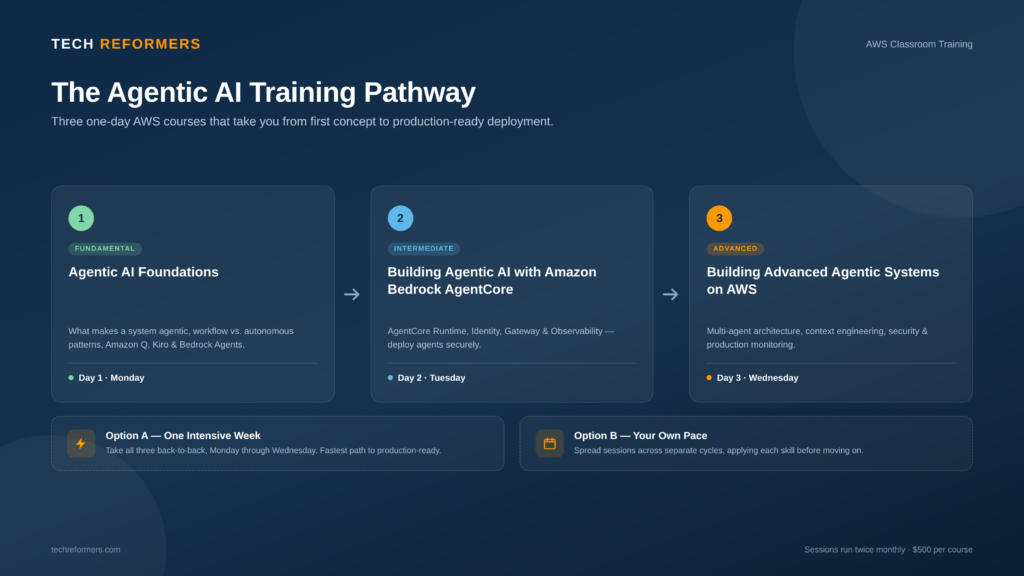
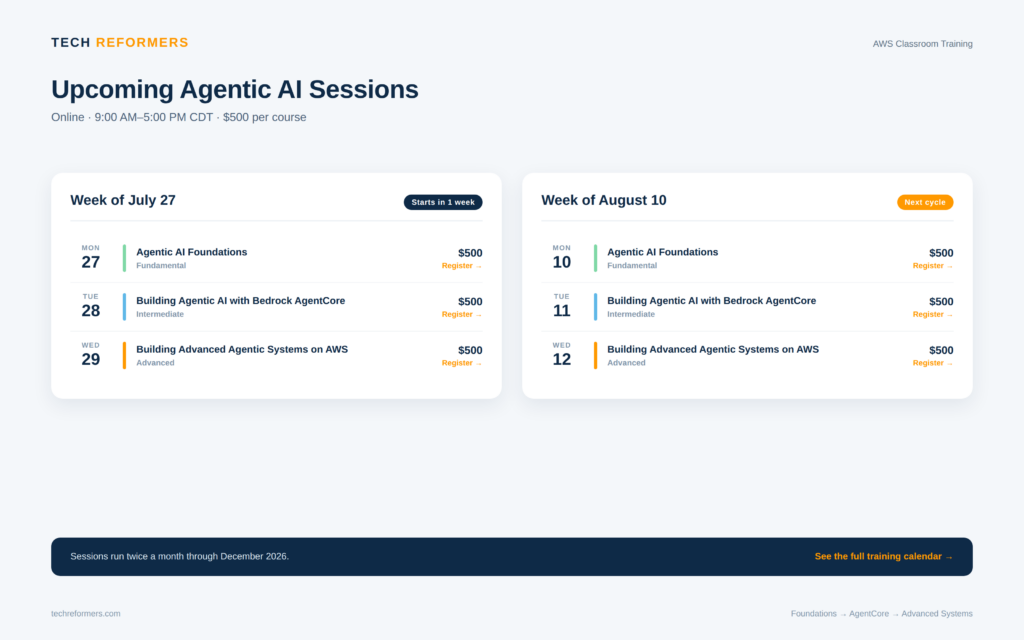
🔗 Explore our upcoming sessions and training paths at https://techreformers.com

CloudWatch icon. CloudWatch auto-enablement now covers CloudFront logs, Security Hub CSPM findings & Bedrock AgentCore telemetry. Zero manual setup

What CloudFront, Security Hub, and Bedrock AgentCore Mean for Your AWS Career

CloudWatch icon. CloudWatch observability auto-enablement now covers CloudFront logs, Security Hub CSPM findings & Bedrock AgentCore telemetry. Zero manual setup

Observability used to be something you configured. Now, with expanding auto-enablement in Amazon CloudWatch, it is something you govern. AWS has added three significant resource types to CloudWatch’s automatic telemetry configuration capability. If you are pursuing AWS certification or working in cloud operations today, this announcement deserves your full attention. It touches monitoring architecture, security posture management, and generative AI observability all at once. Understanding this feature is not just about keeping up with AWS news. Instead, it is about understanding how modern, scalable cloud architectures actually work.

What Auto-Enablement in CloudWatch Actually Does

Before this expansion, setting up logging and telemetry for resources such as CloudFront distributions often required manual per-resource configuration or custom automation scripts. CloudWatch’s auto-enablement capability introduced the concept of enablement rules. These are policies that tell AWS to automatically configure telemetry for existing and newly created resources without human intervention. Think of it less as a toggle and more as a standing order. Any resource that matches the rule has monitoring turned on automatically. This is a foundational shift from a reactive logging setup to proactive, policy-driven observability.

The Three New Resource Types and Why They Matter

The expansion covers three distinct areas of the AWS ecosystem. First, Amazon CloudFront Standard access logs can now be automatically routed to CloudWatch Logs using organization-wide enablement rules. Consequently, it makes consistent CDN visibility available across every account in an AWS Organization without manual distribution-level configuration. Second, AWS Security Hub CSPM (Cloud Security Posture Management) finding logs now support the same organization-wide scope. As a result, security teams can automatically aggregate posture findings into CloudWatch without building custom pipelines. Third, Amazon Bedrock AgentCore memory, gateway logs, and traces are now supported at the account level. All this give AI developers automatic observability into their agent-based applications from the moment those resources are created.

Governance at Scale: Organizations, Accounts, and Tags

One of the most exam-relevant concepts in this announcement is the scoping model for enablement rules. Apply rules at three levels: across an entire AWS Organization, to specific accounts, or to specific resources identified by resource tags. This aligns directly with AWS best practices for multi-account architecture and with governance frameworks such as AWS Control Tower and AWS Organizations. A central security team can define a single rule that cascades CloudFront access logs and Security Hub findings to CloudWatch across every account. For certification candidates studying governance, multi-account strategies, and least-privilege automation, this is a concrete, real-world example of policy-as-configuration.

A Real-World Scenario: The Enterprise Security Team Use Case

CloudWatch gives observability across Organization accounts automatically

Imagine a global e-commerce company running hundreds of CloudFront distributions across a multi-account AWS Organization. Their security operations team needs to ensure that every distribution’s access logs are captured and searchable for incident response and compliance auditing. Before auto-enablement rules, this meant either onboarding scripts, manual configuration per account, or relying on developers remembering to enable logging at deploy time. All of these options create gaps. With a single org-wide CloudWatch enablement rule, every CloudFront distribution — existing ones and every new one created going forward — automatically sends logs to CloudWatch Logs. Pair that with a Security Hub CSPM enablement rule. As a result, the security team now has a unified, automatically populated observability layer with no ongoing maintenance overhead.

Certification Exams and Job Roles This Directly Supports

Solutions Architect badge will help you with observability.

This announcement is relevant across multiple certification tracks. Candidates preparing for the AWS Certified Solutions Architect – Associate and AWS Certified Solutions Architect – Professional exams should note the governance, multi-account design, and monitoring architecture angles. The AWS Certified Cloud Practitioner exam tests foundational understanding of CloudWatch’s role in monitoring and compliance, and this feature reinforces that knowledge. For the AWS Certified AI Practitioner, the Bedrock AgentCore telemetry component introduces an observability dimension to generative AI workloads that is increasingly appearing in AI-focused learning paths. From a job role perspective, CloudOps engineers, cloud security engineers, and solutions architects working in regulated industries or enterprise environments will find this feature immediately applicable. If your organization runs any meaningful CloudFront footprint or is maturing its generative AI operations, this capability belongs in your architecture toolkit now.

Start Building with These Concepts Today

AWS ATP badge. Tech Reformers is an AWS Authorized Training Provider

AWS continues to raise the bar on what automated, policy-driven observability looks like at enterprise scale. CloudWatch auto-enablement rules are not a minor quality-of-life update. Instead, they represent a meaningful architectural capability that exam writers, hiring managers, and cloud architects all care about. Understanding how to scope these rules, which resource types they support, and how they interact with AWS Organizations is the kind of nuanced knowledge that separates certified professionals who passed a test from practitioners who can design production systems. At TechReformers, we bring these announcements to life through real-world context, hands-on labs, and demos built around the official AWS curriculum. Visit us at https://techreformers.com to explore our upcoming training, stay ahead of announcements like this one, and build the skills that actually move your career forward.

Security Agent icon

The compliance question that keeps security teams up at night has always been: “How do I know everything is actually encrypted?” Not theoretically encrypted. Not encrypted-most-of-the-time. Actually, provably, audit-ready encrypted. And encrypted across every network path, every load balancer, every container workload. AWS just made that question a lot easier to answer. With the launch of VPC Encryption Controls in AWS GovCloud (US-East) and GovCloud (US-West), teams can now monitor, enforce, and demonstrate encryption in transit across their entire VPC footprint with a few clicks. For anyone studying AWS certifications or working in regulated industries, this is a capability shift worth understanding deeply. Let’s break it down.

security icon

What Are VPC Encryption Controls

AWS has long provided hardware-based AES-256 encryption transparently between modern EC2 Nitro instances, across Availability Zones, and across Regions for inter-region traffic using VPC Peering, Transit Gateway Peering, and AWS Cloud WAN. The encryption was there, but visibility was not. Before this feature, confirming that every network path was actually encrypted required manual investigation and custom tooling. Additionally, it required a lot of trust. VPC Encryption Controls changes that by giving you a centralized control plane to monitor the encryption status of all traffic flows. You can identify VPC resources that unintentionally allow plaintext traffic and automatically enforce encryption. It also generates audit logs, which compliance officers have been asking for since practically forever.

What Gets Encrypted and How?

The encryption itself is hardware-based AES-256, applied transparently — meaning your applications do not need to change. VPC Encryption Controls extends this enforcement to traffic involving AWS Fargate, Network Load Balancers, and Application Load Balancers. This is in addition to EC2 Nitro instance traffic already covered. The “transparent” part is critical here: this is not application-layer TLS that you configure in your code or in your load balancer listener. This is a network-layer, hardware-accelerated encryption layer that AWS applies automatically once you enable enforcement mode. For multi-VPC architectures, this means you can enforce consistent encryption standards across complex topologies without coordinating changes across dozens of application teams.

Why GovCloud and Why Does It Matter for Compliance?

datalake

GovCloud regions exist specifically to support US government workloads and the compliance frameworks that come with them — FedRAMP, HIPAA, PCI DSS, FIPS 140-2, and others. These frameworks do not just require encryption; they require evidence of encryption. The ability to generate audit logs that demonstrate encryption in transit across all VPC traffic paths is not a nice-to-have in these environments — it is a certification requirement. Before VPC Encryption Controls, customers had to assemble this evidence from fragmented sources, which introduced audit risk and significant operational overhead. Now, your information security team can enable the feature centrally and set enforcement policies. They can also produce clean audit logs on demand. For any organization pursuing or maintaining a FedRAMP Authorization to Operate (ATO), this is a meaningful operational simplification.

Real-World Scenario: A Federal Contractor’s Compliance Sprint

Imagine a cloud engineering team at a federal contractor running a multi-tier application in GovCloud. They have EC2 Nitro-based application servers, containerized microservices on Fargate, and traffic flowing through both an Application Load Balancer and a Network Load Balancer. Ahead of an annual FedRAMP audit, their compliance officer asks for evidence that all intra-VPC and inter-VPC traffic is encrypted in transit. Previously, this meant pulling logs from multiple sources, cross-referencing instance types, and hoping nothing was missed. With VPC Encryption Controls enabled, the team can pull a single audit report showing encryption status across all traffic flows. They can identify a legacy EC2 instance type that was allowing plaintext traffic, remediate it, and hand the auditor a clean log — all before the audit kicks off. That is not a hypothetical; that is the exact use case AWS designed this feature for.

Certification Exam Implications — What You Need to Study

AWS Security Specialty Badge

This feature directly supports learning objectives that appear across multiple AWS certification exams. For the AWS Certified Security Specialty exam, expect scenarios that test your knowledge of encryption-in-transit architecture, compliance framework requirements, audit log generation, and the difference between application-layer and network-layer encryption. The AWS Certified Solutions Architect Associate exam tests VPC design, data protection strategies, and the selection of appropriate encryption controls for different workloads. VPC Encryption Controls is a perfect case study. For professionals pursuing roles as Solutions Architects, CloudOps Engineers, or Security Engineers in government or regulated industries, understanding how to enable, configure, and interpret VPC Encryption Controls is quickly becoming both a practical job skill and an exam topic. If you are studying for any of these exams, add encryption-in-transit enforcement, AES-256 hardware encryption, and compliance audit logging to your active study list right now.

Start Learning This Before Your Exam — or Your Next Audit

AWS VPC Encryption Controls in GovCloud is one of those features that sits at the exact intersection of real-world urgency and exam relevance. It solves a genuine compliance pain point, and it introduces important architectural concepts. It is the kind of capability that will absolutely appear in scenario-based exam questions. At TechReformers, we help certification candidates and enterprise learners connect announcements like this one to the hands-on skills and exam knowledge that actually move careers forward. Whether you are preparing for a security certification or upskilling your team for regulated cloud environments, we have the labs, context, and expert instruction to get you there. Visit us at https://techreformers.com to explore our upcoming courses and get ahead of what AWS is building next.

AWS Outage key image (decorative)

On October 20, 2025, AWS (Amazon Web Services) experienced a significant outage that took down thousands of services worldwide. Snapchat, Venmo, Robinhood, Roblox, Fortnite, Ring, and Alexa all went dark because of the AWS outage, leaving millions of users unable to access critical services and applications.

At Tech Reformers, an AWS Advanced Services Partner and Authorized Training Provider, we were busy working with state and local agencies, K-12 schools, and businesses. During an outage like this, our communication channels start “ringing.” People were worried. They depend on services that run on AWS, and if AWS has problems, their work stops.

So let’s break down what happened, why it matters, and what you can do to be prepared.

What Caused the AWS Outage?

The trouble started at 3:11 AM ET in AWS’s us-east-1 region (Northern Virginia). Multiple services began showing higher error rates and increased latency. By 5:01 AM, AWS engineers identified the culprit: DNS resolution issues affecting the DynamoDB API endpoints. That is, the managed database system lost meaningful connectivity.

Understanding DNS

DNS (Domain Name System) deserves some explanation because it’s at the heart of this outage. DNS is essentially the internet’s address book—it translates human-readable names (like “dynamodb.us-east-1.amazonaws.com”) into the IP addresses that computers use to connect.

Here’s the critical part: DNS isn’t controlled by any single company. It’s a distributed service run by independent organizations and agencies worldwide. These DNS servers are deployed worldwide and need to be continually refreshed with updated information. When DNS breaks—as it did in this case—applications can’t find the services they need to connect to, even if those services are running perfectly fine.

In this case, DynamoDB—a core database service many applications depend on—became unreachable because DNS couldn’t resolve its endpoints. The problem required manual interventions to bypass faulty network components. Complete recovery was achieved by 1 PM ET, though some services experienced lingering slowness into the evening.

The AWS us-east-1 Outage Factor

Here’s what makes this outage particularly significant: us-east-1 is AWS’s largest region (and its first). It started in 2006, running the first three services—SQS, S3, and EC2. Perhaps because of this history, many AWS global services depend on us-east-1 for critical functions.

When us-east-1 has problems, workloads around the world can be affected even if their own regional infrastructure is running perfectly.

Services with Known us-east-1 Dependencies

Several AWS services have dependencies on us-east-1:

  • IAM and IAM Identify Center – Authentication and access management
  • DynamoDB Global Tables – Cross-region database replication and coordination
  • Amazon CloudFront – CDN (Content Delivery Network)

Sometimes you can’t avoid these dependencies. Instead, you need to build resilience around them.

Who Was Actually Affected?

Here’s what we’re hearing from our customers: their own infrastructure on AWS was fine. They were affected because services they depend on went down—Slack stopped working during critical meetings, payment systems couldn’t process transactions, and communication tools went silent. But they’re worried that next time, they could be affected.

The outage hit:

  • Financial Services: Robinhood and Coinbase couldn’t process transactions
  • E-commerce: Amazon.com itself went down, along with McDonald’s and Starbucks apps
  • Transportation: United Airlines and Delta reported delays
  • Government Services: Medicare’s enrollment portal stopped working
  • Collaboration Tools: Slack and other productivity apps slowed to a crawl
  • Gaming: Roblox, Fortnite, and Pokémon GO became unplayable

You can joke about some of these: Aren’t delays the norm from United and Delta? Well, did the gamers have to get to work? Maybe crypto- and day traders profited from holding anyway. But the outage is serious business.

For schools managing daily operations, agencies serving citizens, and businesses running critical workflows, these outages create real problems. When your collaboration tools go down, work stops. When your payment processor goes offline, revenue stops. When your communication systems fail, you can’t reach the people you need to reach.

Many of our customers are now asking: “What can we do about this? We’re vulnerable.”

That’s a fair question. Let’s talk about it.

Building Resilience: What You Can Actually Control

If you’re using SaaS applications that run on AWS, you have limited control over their infrastructure decisions. But you do control your infrastructure:

1. Deploy Multi-Region Architecture

Architect critical workloads to run in at least two geographically separated regions. Use Route 53 health checks and automatic failover to redirect traffic when problems occur.

Example configuration: Deploy your primary workload in us-west-2 (Oregon) and maintain a secondary deployment in us-west-1 (N. California). This geographic separation means different power grids, different network infrastructure, and reduced risk of correlated failures.

This isn’t necessary for everything. Focus on mission-critical workloads first – student information systems, file access, and business systems.

Avoid us-east-1 where possible.

2. Implement Standby Systems

Here’s where we need to talk about money because this is where organizations often hesitate.

Backup and Restore: Cheapest option, but leaves you vulnerable during outages. Recovery takes hours or days. Cost: ~1-2% of primary infrastructure.

Pilot-Light: Set up in another region, not just a backup. The infrastructure is not running but up-to-date and ready to be turned on. Recovery takes minutes to hours. Cost: ~5-10% of primary infrastructure.

Warm Standby (scaled-down infrastructure ready to scale up): Middle ground. You run minimal infrastructure in a secondary region that can quickly scale when needed. Recovery takes minutes. Cost: 20-30% additional.

Multi-site Active/Active (production-scale infrastructure in multiple regions): Most expensive, fastest recovery. Traffic is actively distributed across regions. Recovery is essentially instant. Cost: Can double your infrastructure spending.

The Real Question: What does downtime cost you? AWS itself offers an excellent solution for cross-region replication: AWS Elastic Disaster Recovery. AWS offers four main disaster recovery (DR) strategies to create backups that remain available during disasters. Each strategy has a progressively higher cost and complexity, but lower recovery times.

Avoid AWS outage with Warm Standby and Active/Active DR strategies. They cost more but may be worth it.
Avoid AWS outage with Back & Restore and Pilot Light DR strategies.

For school districts facing deadlines, being down for three hours might mean missed deadlines and frustrated families. For a government agency processing critical permits, six hours of downtime could mean compliance violations. For businesses, money is lost when there are no orders. That’s the calculation you need to make.

We help our clients figure out which workloads justify the extra cost. Not everything needs standby, but your most critical systems probably do.

3. Build Resilience Around Dependencies You Can’t Avoid

You may not eliminate dependencies on services like IAM or CloudFront. But you can reduce your exposure:

Use regional service endpoints: Where AWS offers regional alternatives, use them. Not everything needs to route through global services.

Add an alternative to the Disaster Strategy: Something is better than nothing or errors. Have local or simplified versions of a working architecture.

4. Have Backup Communication Channels

This applies to everyone, whether or not you run AWS infrastructure. When your primary collaboration tools fail, how do you communicate?

Build redundancy into communications:

  • If Slack/Teams goes down, can your team switch to something else?
  • If your primary email provider fails, do you have phone trees in place?
  • Can you reach critical stakeholders through multiple channels?

This sounds basic, but we’ve seen organizations grind to a halt when their primary communication tool goes offline, with no backup plan.

5. Diversify Your Vendors

If possible, don’t put all your critical services on platforms that run on the same cloud provider or ecosystem. This isn’t always feasible, but where you have choices:

  • Use collaboration tools from different providers
  • Consider email/collaboration and data center infrastructure that run on different ecosystems
  • As they say, don’t have all your eggs in one basket

The challenge: many of the best services run on AWS because it’s the largest, most reliable platform.

6. Document and Test Your Workarounds

When services you depend on go down, what’s your plan?

Create documented workarounds:

  • If Teams fails, here’s how we switch to something else…
  • If our file server is down, here’s our process…
  • If our scheduling system fails, here’s our backup approach…

More importantly, test these workarounds—schedule drills. Time them. Make sure your team knows what to do before the emergency happens.

7. Practice Chaos Engineering—But Start with Drills First

Chaos engineering means intentionally breaking things to see how your systems respond. It’s valuable, but you need to walk before you run.

Phase 1: Scheduled Recovery Drills
Run planned failover exercises during maintenance windows. Your team knows it’s coming, they follow the runbook, and you measure how long it takes. Do this until recovery becomes routine.

Phase 2: Unannounced Drills with Random Timing
Once your team can execute recovery smoothly, start adding surprise elements—schedule drills at random times during business hours. Don’t tell the on-call person it’s coming. See if they can follow the runbook under pressure.

Phase 3: Fault Injection in Production
Only after you’ve mastered phases 1 and 2 should you consider using AWS Fault Injection Simulator (FIS) to inject random failures into production systems. Test things like:

  • Regional connectivity failures
  • Database unavailability
  • API throttling scenarios
  • DNS resolution failures

The key is randomness. Real failures don’t happen during convenient maintenance windows. They happen at 3 AM or during your busiest hours. Your systems need to handle that.

Preparing for the Next AWS Outage: Action Steps

Document what happened during this outage if it affected you:

  • Which services did your organization rely on that went down?
  • How long were you unable to work effectively?
  • What was the business impact—missed deadlines, lost productivity, frustrated users?
  • What workarounds did people improvise?
  • What dependencies did you discover that you didn’t know existed?

Identify your critical dependencies:
Make a list of the services your organization absolutely needs to function. For each one, find out:

  • Is it SaaS (managed service) or Cloud infrastructure you control?
  • Does it have built-in redundancy?
  • What’s their uptime SLA?
  • What’s your backup plan if it fails?

AWS Disaster Recovery

AWS is still the best cloud platform for most workloads despite this AWS outage. This outage doesn’t change that. But it reminds us that no system is immune to failure, and dependencies we don’t even think about can bring down services we rely on.

The question isn’t whether another outage will happen—it’s whether you’ll be ready when it does. Be prepared with an AWS disaster recovery plan.

How Tech Reformers Can Help

We’ve worked with schools, agencies, and businesses to build resilient AWS architectures and prepare for disruptions like this one. Our team includes certified AWS Architects and Engineers, as well as AWS Authorized Instructors, all with deep expertise across compute, storage, networking, security, and disaster recovery.

As an AWS Advanced Services Partner and Authorized Training Provider, we offer:

Conducting a Well-Architected Framework Review could help you avoid an AWS outage.

AWS Well-Architected Reviews: We assess your infrastructure against AWS best practices, with a specific focus on reliability and operational excellence. Where are your single points of failure? What’s your actual recovery capability? We’ll tell you.

Disaster Recovery Planning: We help you design and implement multi-region strategies based on realistic requirements and budget constraints. We’ll help you figure out which workloads need hot standby and which don’t.

Resilience Testing Workshops: Hands-on training for your teams on failover procedures, incident response, and building resilient architectures. We’ll help you design and run your first recovery drills.

AWS Training and Certification: Official AWS courses delivered by authorized instructors. Solutions Architect, SysOps Administrator, DevOps Engineer, Security Specialty—we teach them all, both virtual and in-person.

Consulting Services: We work with you on AWS implementations, migration planning, security architecture, and ongoing optimization. Many of our solutions are available on AWS Marketplace.

Ready to avoid an AWS outage and build more resilience into your organization? Contact us for a consultation. Whether you run your own AWS infrastructure or depend on services that do, we can help you prepare for the next disruption.


Additional Resources

Contact Tech Reformers
Phone: +1 (206) 401-5530
Email: info@techreformers.com
Website: https://techreformers.com


AWS Partner Advanced Tier Services badge

We’re excited to share our latest press release:

Leading AWS-focused services and training firm achieves milestone of AWS Advanced Tier Services Partner Status. Marked by successful client deployments and internal training and certification milestones, Tech Reformer met the challenge.

Advanced tier recognition validates Tech Reformers’ deep expertise in cloud migration and AI workloads for public sector, education, and SMB clients.


August 29, 2025 – Tech Reformers, a specialized Amazon Web Services (AWS) service and Authorized Training Provider, today announced it has achieved AWS Advanced Tier Services Partner status. This prestigious recognition acknowledges the company’s demonstrated expertise, successful customer outcomes, training, and commitment to AWS best practices across cloud migration and artificial intelligence implementations.

AWS Partner Advanced Tier Services badge

The Advanced Tier achievement reflects Tech Reformers’ significant investment in AWS expertise, with eight accredited professionals, including four technical and four business specialists. The company has also secured six AWS technical certifications, including three at the Professional or Specialty level, and four AWS Foundational certifications across its team. This milestone was reached through the successful delivery of over 20 launched opportunities, generating more than $10,000 in monthly recurring revenue.

Specialized Focus Drives Success

Unlike generic cloud providers, Tech Reformers maintains an exclusive focus on AWS services. This positions the company as a true specialist in Amazon’s cloud ecosystem. This concentrated expertise, combined with their status as an AWS Authorized Training Provider, creates a unique value proposition. For organizations seeking both implementation services and learning AWS, Tech Reformers “teaches them to fish.”

“Achieving AWS Advanced Tier Services Partner status validates our strategic decision to focus exclusively on AWS and our team’s dedication to mastering the platform’s capabilities,” said John Krull, President of Tech Reformers. “This recognition demonstrates our ability to deliver complex cloud migrations and AI workloads that drive real value for our clients in the public sector, K-12 education, and growing SMB markets. Our dual role as both a service partner and training provider allows us to implement not just solutions. We empower our clients with the knowledge they need to succeed long-term.”

Addressing Critical Market Needs

Tech Reformers specializes in serving three key market segments. First, K-12 districts seeking to modernize their technology infrastructure recognize the expertise of Tech Reformers. Next, public sector organizations navigating cloud adoption see Tech Reformers ability to move Microsoft workloads to AWS. Finally, small to medium-sized businesses taking their first steps into cloud and AI can learn from Tech Reformers’ experience. This focus allows the company to develop deep domain expertise and tailored approaches for each sector’s unique challenges and compliance requirements.

The company’s expertise in cloud migration helps organizations transition from legacy on-premises infrastructure to scalable, secure AWS environments. Additionally, their AI workload specialization positions clients to leverage machine learning, artificial intelligence, and data analytics capabilities. These can transform business operations and decision-making processes.

Comprehensive AWS Expertise

As an AWS Advanced Tier Services Partner, Tech Reformers brings proven capabilities across the full spectrum of AWS services. The company’s certified professionals possess deep technical knowledge in areas including:

  • Cloud Migration Services: End-to-end migration planning, execution, and optimization. Tech Reformers recently completed a migration of the Los Gatos Union School District.
  • AI and Machine Learning: Implementation of AWS AI services for business transformation. Tech Reformers has completed implementations of website AI chatbots, PDF accessibility ML pipeline, and enterprise data tools.
  • Security and Compliance: Robust security measures meeting public sector and educational requirements. All Tech Reformers clients get a secure landing zone with their AWS QuickStart.
  • Training and Knowledge Transfer: Official AWS training delivery as an Authorized Training Provider
  • Cost Optimization: Strategic guidance on maximizing cloud investment returns

Strong Foundation for Growth

The Advanced Tier achievement represents a significant milestone in Tech Reformers’ growth trajectory. AWS categorizes partners into tiers based on expertise, customer success, and service delivery standards, with the Advanced Tier representing a substantial commitment to AWS excellence. Partners must demonstrate technical competency, successful customer implementations, and ongoing investment in AWS capabilities.

AWS remains the world’s most comprehensive and widely adopted cloud platform, offering over 200 fully featured services from its global data centers. Millions of customers – including fast-growing startups, large enterprises, and government agencies – rely on AWS to reduce costs, increase agility, and accelerate innovation.

Looking Forward

With Advanced Tier status now secured, Tech Reformers is well-positioned to serve growing demand for specialized AWS expertise across its target markets. The company’s combination of deep technical capabilities, focused market approach, and training expertise creates a compelling value proposition for organizations seeking to maximize their AWS investments.

Organizations interested in learning more about Tech Reformers’ AWS capabilities can visit https://techreformers.com or contact their team directly to discuss cloud strategy and implementation needs.

About Tech Reformers

Tech Reformers is a specialized AWS services firm and Authorized Training Provider focused exclusively on Amazon Web Services implementations. The company serves public sector, education, and small-to-medium business clients with expertise in cloud migration and AI workloads. Founded on the principle that focused expertise delivers superior outcomes, Tech Reformers combines deep AWS knowledge with targeted market understanding to help organizations achieve their cloud transformation goals.

For more information about Tech Reformers and their AWS services, contact info@techreformers.com or call (+1 (206) 401-5530.

laptop-file-solid icon

Whenever you save a file on your computer, multiple storage technology layers work perfectly to organize your data. This invisible hierarchy has shaped how we store and access information for decades, and now it's influencing the cloud services we use daily. This invisible hierarchy starts at the hardware level with block storage and builds up through operating systems to the file interfaces we use daily. Understanding this foundation becomes even more critical as cloud services like AWS have revolutionized how we think about data storage.

How Block Storage Creates the Foundation

At its most basic level, a computer hard drive begins life as raw storage space divided into uniform blocks, typically 512 bytes or 4KB in size. These blocks are like empty containers waiting to be filled with data. Before you can save your first file, these raw blocks need organization—a job that falls to the operating system and its file system.


Think of block storage as your computer’s physical real estate. Just as a plot of land needs streets and buildings before people can live there, your hard drive needs structure before it can store meaningful data. When your computer writes data to disk, it essentially assigns specific blocks to hold specific information and keeps track of which blocks belong to which files.

The Magic of File Systems

This is where file systems enter the picture. When an operating system formats a drive, it creates a logical structure that maps human-readable files and folders to those underlying blocks. Windows uses NTFS, macOS prefers APFS, and Linux typically employs ext4, but they all serve the same fundamental purpose: translating your request to save “report.docx” into a series of block-level operations.

The file system acts as a sophisticated address book. It remembers not just where each file lives, but also crucial metadata like when it was created, who can access it, and how large it is. This abstraction allows us to organize information in ways that make sense to humans, while the computer efficiently manages the physical storage underneath.

Network Storage: SANs and NAS Expand the Paradigm

As computing evolved, the need for shared storage across networks led to two distinct approaches: Storage Area Networks (SANs) and Network-Attached Storage (NAS). These technologies take the block-file relationship we’ve established and apply it in different ways.

SANs deliver raw block storage over high-speed networks, essentially extending the block-level access that local drives provide. When a server connects to a SAN, it sees additional storage devices as if they were directly attached. The server’s operating system then formats these blocks and manages its own file system, maintaining the same control it would have over local storage.

SANs typically use protocols like Fibre Channel, iSCSI, or FCoE (Fibre Channel over Ethernet). They provide high performance and low latency, making them suitable for applications that need direct disk access.

NAS takes a different approach by providing file-level access over standard network protocols. Instead of getting raw blocks to manage, users connect to an already-formatted file system. The NAS device handles all the block-to-file translation internally, presenting a ready-to-use storage system that multiple users can access simultaneously.

NAS devices provide file-level access over standard network protocols like NFS, SMB/CIFS, or AFP.

Key Differences

The fundamental difference is that SANs operate at the block level (like raw disk access) while NAS operates at the file level. With SANs, the servers maintain control of the file system, while with NAS, the storage device itself manages the file system.

This distinction affects performance, management, and use cases – SANs are often used for high-performance database applications and virtualization, while NAS is commonly used for file sharing and collaborative workflows.

AWS: Cloud Storage Follows Traditional Patterns

AWS has essentially deployed these traditional storage concepts, though it doesn’t explicitly call them SANs or NAS. EBS (Elastic Block Store) functions remarkably like a SAN, providing raw block volumes that EC2 instances can attach and format according to their needs. Each EBS volume acts as an independent disk, requiring the instance’s operating system to manage the file system.

In contrast, Amazon EFS (Amazon Elastic File System) and Amazon FSx for Windows File Server behave like managed NAS solutions. These services present fully functional file systems that multiple EC2 instances can access concurrently.

FSx for Windows uses the SMB protocol, and EFS provides a fully managed NFSv4 file system typically used by Linux.. Multiple EC2 instances can access these shared file storage systems

AWS handles all the underlying complexity of block management, leaving users free to focus on organizing their files and applications.

Why This Matters Today

Understanding this storage hierarchy helps explain why certain operations work the way they do. When you attach an EBS volume to an EC2 instance, you’ll need to format and mount it, just like adding a new hard drive to your computer. But when you connect to EFS, you’re ready to start creating files immediately.

These fundamental principles remain relevant whether you’re managing a single laptop or architecting AWS infrastructure. The abstraction from blocks to files to network storage has shaped how we build and interact with systems, and continues to influence new storage technologies as they emerge. By recognizing these patterns, we can make better decisions about which storage solutions best fit our specific needs.

Keep an eye out for a future article about object storage.

AWS GenAI Scoping Matrix

As Generative AI (GenAI) transforms organizations across industries, education, and the public sector, the security implications have become a critical consideration for organizations of all sizes. At Tech Reformers, we’ve helped numerous clients navigate the complex landscape of AI implementation with AWS solutions. One particularly valuable resource we recommend is AWS’s Generative AI Security Scoping Matrix – a comprehensive framework that provides clarity in an otherwise complex security environment.

Understanding the AI Security Challenge

The rapid adoption of GenAI technologies presents unique security challenges that extend beyond traditional security measures. While core security disciplines like identity management, data protection, and application security remain essential, GenAI introduces distinct risks that require specialized consideration.

Organizations often struggle to determine exactly what security measures they need based on how they’re using AI. This is where AWS’s Generative AI Security Scoping Matrix shines – it offers a structured approach to understanding and implementing appropriate security controls based on your specific AI implementation.

The Five Scopes of AI Implementation

The genius of AWS’s framework lies in its simplicity. It classifies GenAI implementations into five distinct scopes, representing increasing levels of ownership and control over the AI models and associated data.

AWS's Scoping Matrix

Scope 1: Consumer Applications

At this level, your organization simply consumes public third-party generative AI services. Think of employees using applications like ChatGPT or Amazon’s PartyRock to generate ideas or content. You don’t own or see the training data or model, and you can’t modify them.

For example, a marketing team member might use a public AI chat application to brainstorm campaign ideas or generate draft copy. The security focus here is primarily on usage governance and data sharing policies.

Scope 2: Enterprise Applications

This scope involves using third-party enterprise applications with embedded generative AI features. Unlike consumer apps, these typically offer business relationships with vendors and enterprise-grade terms and conditions.

A common example is using enterprise productivity tools that incorporate AI features for meeting scheduling, email drafting, or document summarization. Security considerations expand to include vendor assessment and data handling agreements.

Amazon Q is the most capable generative AI–powered assistant for leveraging organizations’ internal data and accelerating software development.

Scope 3: Pre-trained Models

Moving into more technical implementation, Scope 3 involves building your own applications using existing third-party foundation models through APIs. You’re not modifying the model itself, but you are creating custom integrations.

Many of our clients operate at this level, building custom applications that leverage foundation models like Anthropic Claude through Amazon Bedrock APIs. These implementations often involve techniques like Retrieval-Augmented Generation (RAG) to enhance models with organization-specific information without changing the model itself.

Scope 4: Fine-tuned Models

At this scope, organizations take existing foundation models and fine-tune them with specific business data. This creates specialized versions of models tailored to particular domains or tasks.

For instance, a healthcare client might fine-tune a foundation model with medical terminology and documentation standards to improve summarization of patient records in an EHR system. Security considerations now extend to the training data and the resulting specialized model.

Scope 5: Self-trained Models

The most comprehensive level involves building and training generative AI models from scratch using organizational data. This offers maximum control but also requires the most extensive security considerations.

An example might be creating a custom model for specialized video content generation in the media industry. At this level, organizations own every aspect of the model development and deployment.

Security Priorities Across the AI Lifecycle

AWS’s matrix identifies five key security disciplines that span these different implementation types:

Governance and Compliance

As you move from consumer applications to self-trained models, governance requirements increase significantly. For Scopes 1 and 2, focus on terms of service compliance and establishing clear usage policies. For higher scopes, comprehensive governance frameworks become essential, including model development standards and continuous monitoring processes.

Different regulatory requirements apply based on your implementation scope. Consumer applications require careful attention to data submission practices, while enterprise models demand robust contractual protections. For self-trained models, compliance with relevant data privacy laws becomes paramount, particularly when handling sensitive information.

Risk Management Strategies

The matrix helps identify potential threats specific to each implementation type. For instance, in Scope 3 implementations, organizations should focus on prompt injection vulnerabilities and API security. For Scopes 4 and 5, data poisoning and model extraction attacks become more significant concerns.

Security Controls Implementation

Practical security measures vary across scopes. Lower scopes emphasize access controls and data handling policies, while higher scopes require technical safeguards like training data validation, adversarial testing, and model output filtering.

Resilience Planning

Building resilient AI systems means addressing availability requirements and business continuity considerations. For mission-critical AI applications, this might include redundancy planning, fallback mechanisms, and continuous monitoring solutions.

Practical Application for Your Organization

Based on our work with clients across industries, we recommend a phased approach to implementing AWS’s security framework:

  1. Accurately scope your current and planned AI implementations – Most organizations operate across multiple scopes simultaneously, so mapping your activities to the matrix is an essential first step.
  2. Prioritize security disciplines based on your specific risk profile – Not all security considerations are equally important for every organization. Identify your most critical concerns based on your industry, data sensitivity, and regulatory environment.
  3. Implement appropriate controls progressively – Start with fundamental security measures and expand your security program as your AI implementations mature.
  4. Continuously reassess as your AI strategy evolves – The rapid advancement of AI capabilities means your security approach must be flexible and regularly updated.

Moving Forward with Confidence

The AWS Generative AI Security Scoping Matrix provides a valuable mental model for organizations navigating the complex intersection of innovation and security. By understanding where your implementations fall within this framework, you can apply appropriate security measures without unnecessarily constraining your ability to realize AI’s transformative potential.

At Tech Reformers, we’re helping organizations leverage this framework to build secure, effective AI strategies on AWS. The matrix provides clarity without oversimplification – acknowledging that different AI implementations require distinct security approaches.

To explore the complete Generative AI Security Scoping Matrix and learn more about AWS’s comprehensive approach to AI security, read more at the official AWS resource.

Tech Reformers logo

Need help implementing these security principles in your organization? Contact Tech Reformers today to discuss how we can help you build a secure, effective generative AI strategy on AWS.

Amazon Q customized to "Daisy"

Remember when you spent countless hours digging through files and spreadsheets (when you could find them)? Thanks to Amazon Q, the Generative Artificial Intelligence (Gen AI) platform with the potential to revolutionize how organizations manage their daily operations, those days could be a thing of the past. As someone who works with businesses and technology teams, I’m excited to share how this solution makes administrative tasks manageable and enjoyable.

Single Sign-on and Application Portal

login dialog

Amazon Q Business works with the AWS single sign-on that can tie into your identity system, like Microsoft Entra or Google.

Once signed in, your Amazon Q Business Apps and other applications are available in your AWS access portal.

AWS access portal

The Simplicity and Elegance of Amazon Q

Amazon Q brings sophisticated Gen AI technology to any sector, allowing for secure AI access to organizational data. Imagine having an assistant who knows details of your company’s operations and can answer complex questions based on your data in seconds. The system’s natural language processing capabilities mean administrators can ask questions as they would to a colleague and receive immediate responses with verifiable content and source information.

Customized Q screen, renamed Daisy, District AI Search and Productivity

Here is Q Business customized as “Daisy.”

Making Daily Tasks a Breeze

Let’s talk about real-world impact. Picture your HR director asking Amazon Q about certifications for the upcoming year. Instead of manually reviewing hundreds of records, they receive an instant analysis. The financial team can explore budget trends with natural questions like “How has our training and professional development spending changed since last fall?” Amazon Q doesn’t just provide numbers – it offers context and insights that help inform better decisions.

Q Business can be tied to only data or configured as shown to provide access to all the Large Language Models (LLMs).

Q chat interface showing options Company Knowledge and General Knowledge
Graphic of explanations

Amazon Q in QuickSight: Your Data Storyteller

While Amazon Q Business handles your day-to-day questions, Amazon Q in QuickSight transforms complex data into clear, actionable insights. Managers would appreciate how they turn enrollment numbers, budget data, and academic metrics into compelling visualizations. The system accepts natural language prompts to produce visualizations.

Sample QuickSight Dashboards

A data analyst did not make these dashboard graphs, but Amazon Q in QuickSight created them from simple natural language prompts from a user without Business Analysis or AI skills.

Q chat in QuickSight enables any user to create dashboards.

QuickSight Q chat interface

Imagine starting your day with a quick check of key metrics across your organization. Amazon QuickSight pulls data from various systems – your Student Information System, financial software, and HR platforms – and presents it in a clear, understandable format. When the superintendent needs a last-minute report on cross-company performance metrics, they can generate it themselves, or if they ask you, it won’t ruin your morning.

Security is Job 0

Data security isn’t just a checkbox; it’s a fundamental requirement. Amazon Q takes this responsibility seriously with a comprehensive security approach designed for the most security-conscious institutions. AWS does not have access to or use your data for model improvement. The platform maintains compliance while protecting sensitive student information through advanced encryption and access controls. Your data stays within your AWS environment, giving you complete control over your information. All user queries and model responses can be logged for secure audits.

Beyond Basic Administration

Setting up Amazon Q feels less like implementing new technology and more like welcoming a new team member. Try before you buy and pay-as-you-go pricing removes the requirement for a large upfront investment. The platform complements your existing workflows, connecting smoothly with your current systems while respecting established security protocols. Whether you use Microsoft, Google, or a mix of platforms, Amazon Q fits right in. You can use your existing identity system for single sign-on, and Q respects the permissions of your data stores.

Easy to administer controls.

Built-in connectors for S3, web crawlers, files, and shared file systems, including Microsoft and Google.

Growing Smarter Together

One of the most exciting aspects of Amazon Q is its continuous evolution. It learns from interactions with your content, becoming more valuable over time. Regular updates deliver new capabilities aligned with real customer needs, ensuring the platform grows alongside your evolving requirements.

As AI continues to evolve, Amazon Q stands ready to support organizations in meeting new challenges. From handling routine administrative tasks to providing deep insights for strategic planning, it’s transforming how companies operate. The platform’s intelligence, security, and ease of use make it an invaluable partner.

Next Steps

Ready to see how Amazon Q can transform your operations? Connect with Tech Reformers for a personalized demonstration tailored to your needs. Learn how this innovative technology can help your team focus on what matters most.

Tech Reformers logo
ArcGIS logo

Are you struggling with the limitations of running ArcGIS Pro on standard work laptops? It’s time to consider a cloud-based solution. Amazon AppStream 2.0 offers a game-changing approach to deploying ArcGIS Pro, bringing numerous benefits to your organization.

Why Move ArcGIS Pro to AWS?

Cloud-based ArcGIS Pro eliminates the need for powerful, expensive hardware at each workstation. Users can access the application from any device with an internet connection, enabling flexible remote work. IT teams can centrally manage and update the software, ensuring all users have the latest version without individual installations.

Data security improves as sensitive GIS data remains in the cloud rather than on local machines. For organizations dealing with large datasets or complex GIS tasks, AppStream 2.0 provides scalable, on-demand resources. This solution leads to cost savings, improved collaboration, and greater operational efficiency.

ArcGIS logo

Steps to Setup AppStream for ArcGIS Pro

Before diving into AppStream 2.0, you’ll need to, of course, set up your AWS account. Start by creating the necessary network resources. This includes:

Creating an AppStream 2.0 Image Builder

The next step is to create an image builder, which is an EC2 instance used to install and configure ArcGIS Pro for streaming. You’ll:

  • Launch an image builder from a base image
  • Connect to the image builder using remote desktop
  • Install and configure ArcGIS Pro
  • Join the image to Active Directory, if using AD.

Creating Your AppStream 2.0 Image

Once ArcGIS Pro is installed, you’ll use the Image Assistant to:

  • Create an application catalog
  • Optimize launch performance
  • Configure image settings
  • Create the final image for deployment

Provisioning a Fleet

With your image ready, you’ll set up a fleet of instances to stream ArcGIS Pro. This involves:

  • Choosing the appropriate instance type (e.g., Graphics Design instances for 3D workloads)
  • Configuring fleet capacity and scaling policies
  • Setting up network configurations

Creating a Stack and Managing User Access

The final steps in the deployment process include:

  • Creating an AppStream 2.0 stack, which combines your fleet with user access policies
  • Setting up user management through AppStream 2.0’s user pool or integrating with your existing identity provider
  • Configuring persistent storage

Enhance Your GIS Workflow with AWS File Storage

Moving your file server to AWS alongside ArcGIS Pro on AppStream 2.0 further optimizes your GIS workflow. AWS offers multiple file storage options that integrate seamlessly with AppStream 2.0:

  1. Amazon FSx for Windows File Server: A fully managed native Windows file system, ideal for Windows-based environments.
  2. Amazon S3 and AWS Storage Gateway: Object storage for large amounts of GIS data that can be synched with on-prem storage and creates hybrid storage solution good for migration.

These options provide flexibility, scalability, and cost-effectiveness for your GIS data management needs. All allow integration with Active Directory and utilizing a file share similar to what you are moving away from on-prem

Streamline User Management with AWS Directory Service

Transitioning to AWS presents an opportunity to move your Active Directory to the cloud, benefiting your entire organization. AWS Directory Service offers a fully managed, highly available Microsoft Active Directory in the AWS Cloud.

This service simplifies user management, enhances security with features like multi-factor authentication, and enables single sign-on across AWS services and applications. It eliminates the need for on-premises domain controllers, reducing IT overhead and improving reliability.

By moving ArcGIS Pro, file storage, and Active Directory to AWS, you create a cohesive, scalable, and secure IT infrastructure for your organization.

Take Action Now

Tech Reformers, an AWS partner, recently helped a public sector organization successfully migrate their ArcGIS Pro environment, file servers, and Active Directory to AWS. Our team of experts can guide you through this transformative process, tailoring the solution to your specific needs.

Don’t let outdated infrastructure hold back your GIS capabilities. Try it yourself with guidance from ESRI or contact Tech Reformers to learn how we can help you leverage the power of AWS for your ArcGIS Pro deployment and beyond. Let’s unlock the full potential of your GIS workflow together.

Cartoon-figures-watching-an-AWS-presentation

AWS AI-Powered Tools to Reshape the Future

Tech Reformers recently participated in the AWS PartnerEquip Live event held in Washington DC from September 30 to October 3, 2024. PartnerEquip Live caters exclusively to AWS Specialization Partners, including those with AWS Competency, Managed Service Provider, Service Delivery, and Service Ready designations. This elite gathering grants unparalleled access to strategic and forward-looking AWS content. Attendees gain invaluable insights into product roadmaps, sneak peeks at upcoming feature releases, and exclusive demonstrations of cutting-edge technologies. The event series empowers partners to dramatically enhance their technical capabilities and craft powerful co-sell strategies alongside AWS experts. This unique opportunity positions Tech Reformers at the forefront of cloud innovation, ready to deliver exceptional value to our clients.

This gathering for AWS Specialized Partners unveiled advancements in AI-driven developer tools dubbed the “next-generation developer experience” (NGDE). We dove deep into Amazon Q Business and QuickSight Q. The event showcased how generative artificial intelligence transforms software development, enterprise operations, business intelligence, and DevOps practices.

Amazon Q: The Game-Changing AI Assistant

The star of the event was undoubtedly Amazon Q, AWS’s powerful new AI assistant. It comes in several flavors including Amazon Q Developer for software and systems engineers, Amazon Q Business for enterprise users, QuickSight Q for Generative Business Intelligence or “Gen BI.” Tech Reformers has been helping several organizations launch Amazon Q with our Q Business QuickStart. Let’s dive deeper into these transformative tools.

Amazon Q Developer: Supercharging Software Development and IT

Amazon Q Developer emerges as a groundbreaking AI-powered assistant designed to upend the software development process. This versatile tool offers a wide array of features that significantly enhance developer productivity and code quality:

Mockup image of Q Developer chat
  1. Code Recommendations and Enhancements: Amazon Q Developer provides intelligent suggestions to improve code efficiency and readability. It analyzes existing codebases and offers context-aware recommendations, helping developers write cleaner, more maintainable code.
  2. Automated Feature Development: One of the most impressive capabilities of Amazon Q Developer is its ability to automate feature development. By understanding project requirements, it can generate entire code snippets or even complete features, dramatically reducing development time.
  3. Security Scanning: With cybersecurity concerns at an all-time high, Amazon Q Developer integrates advanced security scanning capabilities. It detects potential vulnerabilities and security policy violations in real-time, allowing developers to address issues before they make it into production.
  4. Code Transformations: Legacy code often hinders progress and innovation. Amazon Q Developer tackles this challenge head-on with its code transformation features. It can modernize outdated code, convert between programming languages, and adapt code to new frameworks or best practices.
  5. Customization Options: Recognizing that every development team has unique needs, Amazon Q Developer offers extensive customization options. Teams can tailor the AI assistant to align with their specific coding styles, project structures, and development workflows.
Cartoon-figures-watching-an-AWS-presentation

Amazon Q Business: Unlocking Enterprise Intelligence

While Amazon Q Developer focuses on software engineering, Amazon Q Business aims to revolutionize how enterprises interact with their data and systems:

  1. Natural Language Interactions: Amazon Q Business enables employees to query enterprise data using natural language. This democratizes access to information, allowing non-technical users to derive insights without relying on data analysts or complex query languages.
  2. Intelligent Summaries and Content Generation: The AI assistant can quickly summarize large documents, generate reports, and create content based on enterprise data. This feature saves employees countless hours previously spent on manual data analysis and content creation.
  3. Task Automation: Amazon Q Business can complete various tasks across different enterprise systems. From scheduling meetings to generating expense reports, it streamlines numerous business processes.
  4. Customizable Plugins: Plugins offer extensibility . This allows organizations to integrate the AI assistant with their proprietary systems and tailor its capabilities to their specific needs.

Gen BI with Amazon QuickSight Q

Amazon Q with QuickSight, AWS’s business intelligence tool, brings generative AI capabilities to data visualization. Users can create and modify charts, graphs, and dashboards using natural language commands, reducing the time to insight from hours to minutes.

AWS App Studio: Democratizing Application Development

One of the most exciting revelations at the PartnerEquip:Live event was AWS App Studio, a new service in preview that democratizes application development through the power of generative AI.

Natural Language Application Development

AWS App Studio harnesses natural language processing to revolutionize the way enterprise-grade applications are built. This innovative approach empowers a whole new category of builders to create sophisticated applications in a matter of minutes, not months.

Expanding the Developer Pool

With App Studio, AWS breaks down traditional barriers to application development. Technical professionals who may lack deep software development skills can now take the lead in creating custom business applications for internal use. This includes:

  1. IT project managers
  2. Data engineers
  3. Enterprise architects

These professionals can leverage their domain expertise and organizational knowledge to rapidly develop applications tailored to their specific business needs.

Introducing AWS App Studio – Generative AI-Powered Low-Code Application Development

Empower Your Organization with AI-Driven Tools from Amazon

The AWS PartnerEquip event showcased how Amazon Q is set to transform business operations and software development. This powerful AI assistant, with its developer and business variants, offers practical solutions to enhance productivity, streamline processes, and unlock new capabilities within organizations. From intelligent coding assistance to natural language data interactions, Amazon Q provides tools that can significantly impact your bottom line. From Amazon Q to App Studio’s natural language application development, these innovations promise to dramatically enhance productivity, accelerate digital transformation, and democratize software creation and business intelligence.

As an AWS Specialized Partner, Tech Reformers is ideally positioned to help your organization leverage these innovations effectively. Don’t miss out on the competitive advantages these AI-driven tools can offer. Contact Tech Reformer today to learn how we can implement Amazon Q to boost efficiency and drive innovation in your enterprise.

Tech Reformers Chat
Open Tech Reformers Chat